Company profile
EduCoursesPro: practical programming education, built around working code
EduCoursesPro is an online learning platform for programming and technology. It is operated by EDUCOURSESPRO LTD, a private limited company registered in England and Wales. This page sets out the company facts, what is available today, and what we can prepare for an institution on request.
Legal registration
- Legal name
- EDUCOURSESPRO LTD
- Company number
- 17212608
- Registered in
- England and Wales (private limited company)
- Incorporated
- 12 May 2026
- Registered office
- 71-75 Shelton Street, Covent Garden, London, WC2H 9JQ, United Kingdom
- Registered activities (SIC)
- 62012 – Business and domestic software development
- 85590 – Other education not elsewhere classified
- 85600 – Educational support services
- Director
- Fawaz Mohammed Abdo Ali (sole director)
The founder
The company was founded by its director, Fawaz Mohammed Abdo Ali. He writes and teaches the courses on the platform, where he appears as Fawaz Almekhlafi: the lectures, the source code that accompanies them and the technical guides.
He also directs the development of the platform itself. Institutions talk directly to the person responsible for the content and for the platform.
What we offer
We separate clearly what an institution can use today from what we prepare on request. Nothing in the second list is presented as available until it is built and tested.
- Seven published courses: Python (foundations to object-oriented programming and projects), data processing with Pandas, two web GIS courses with the ArcGIS Maps SDK for JavaScript, Angular, ASP.NET Core Web API and ASP.NET MVC.
- Video lectures in a web player that saves progress, with personal notes and in-video checkpoint questions where a lecture includes them.
- Source code attached to lectures of the Python course (for example lecture 26, downloadable as a zip), and complete projects built across lectures.
- A certificate of completion for each completed course.
- An interactive demo centre where Python examples run in the browser, in an isolated sandbox.
- Custom programmes and pilot programmes for a cohort, with an agreed scope, duration and success criteria.
- Mapping our modules to your curriculum and learning outcomes, prepared with your teaching staff.
- Versions of courses in other languages (for example English, French or Romanian), produced and reviewed before they are offered.
- Group and institutional licences, priced in a formal quotation approved by the company.
- Accredited qualifications or academic credit: our certificates of completion are issued by EduCoursesPro and are not accredited by a public body or a university.
- Integrations with learning management systems (SCORM, xAPI, LTI) and single sign-on (SSO): not available yet.
- Institution and supervisor dashboards, and group enrolment of learners: in development, not available yet.
Project-based learning, in practice
Every course is built around programs that run. Learners do not just watch: they build, change and finish working software, and the assessment looks at what they built.
- 1
Start from a working program
Each lecture opens with the result it will build, so the learner knows what "done" looks like.
- 2
Build it step by step
The code is written on screen, one idea at a time, and run after each step.
- 3
Change it yourself
An exercise asks the learner to extend the program; a check confirms whether the change works.
- 4
Bring it together in a project
Sections end in an integrated project, for example a student and course management system that saves results to files.
- 5
Show what you built
Checkpoint questions, quizzes and a final project measure what the learner can do, not what they remember.
- 6
Keep the code
The source code stays available to revisit and reuse in later projects.
A real example
In lecture 26 of the Python course, learners build Student objects with names and scores. In the demo centre you can run the exact code from that lecture, read the explanation and complete the follow-up exercise, which is checked automatically.
Run it →Published courses
These are the courses currently published on the platform, with direct links. The list is read from the platform when this page is generated.
All published courses are taught in Arabic. Course pages can be displayed in other languages; the lectures themselves are in Arabic.
Data processing using Python and the Pandas library
9 lectures · 2.2 hours of video
Open the course page →سلسلة دروس ArcGIS Maps SDK for JavaScript بالعربي
23 lectures · 3.6 hours of video
Open the course page →Python and Artificial Intelligence: From Zero to Building Smart Applications and Projects
31 lectures · 5.9 hours of video
Open the course page →Introduction to Angular and understanding how modern web applications work
16 lectures · 2.7 hours of video
Open the course page →Master Web API with Angular for a Clinic Management system
7 lectures · 1.0 hours of video
Open the course page →Mastering (GIS) with ArcGIS Maps SDK for JavaScript
29 lectures · 5.2 hours of video
Open the course page →asp.net mvc series of lessons with a practical application on an e-commerce website management system - Shop with us
36 lectures · 16.8 hours of video
Open the course page →
The platform, as learners see it
Screenshots taken from the public platform on 28 November 2026.
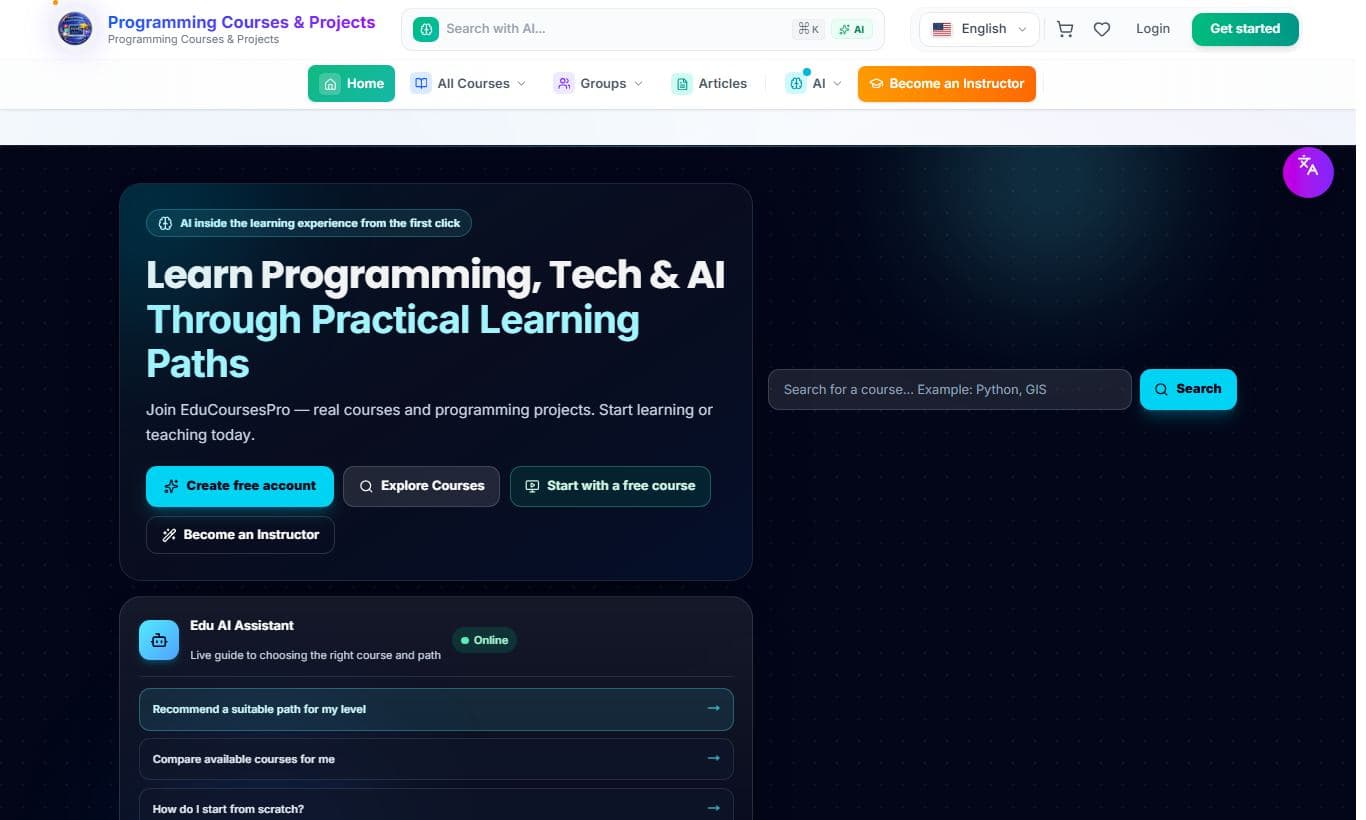
Home page 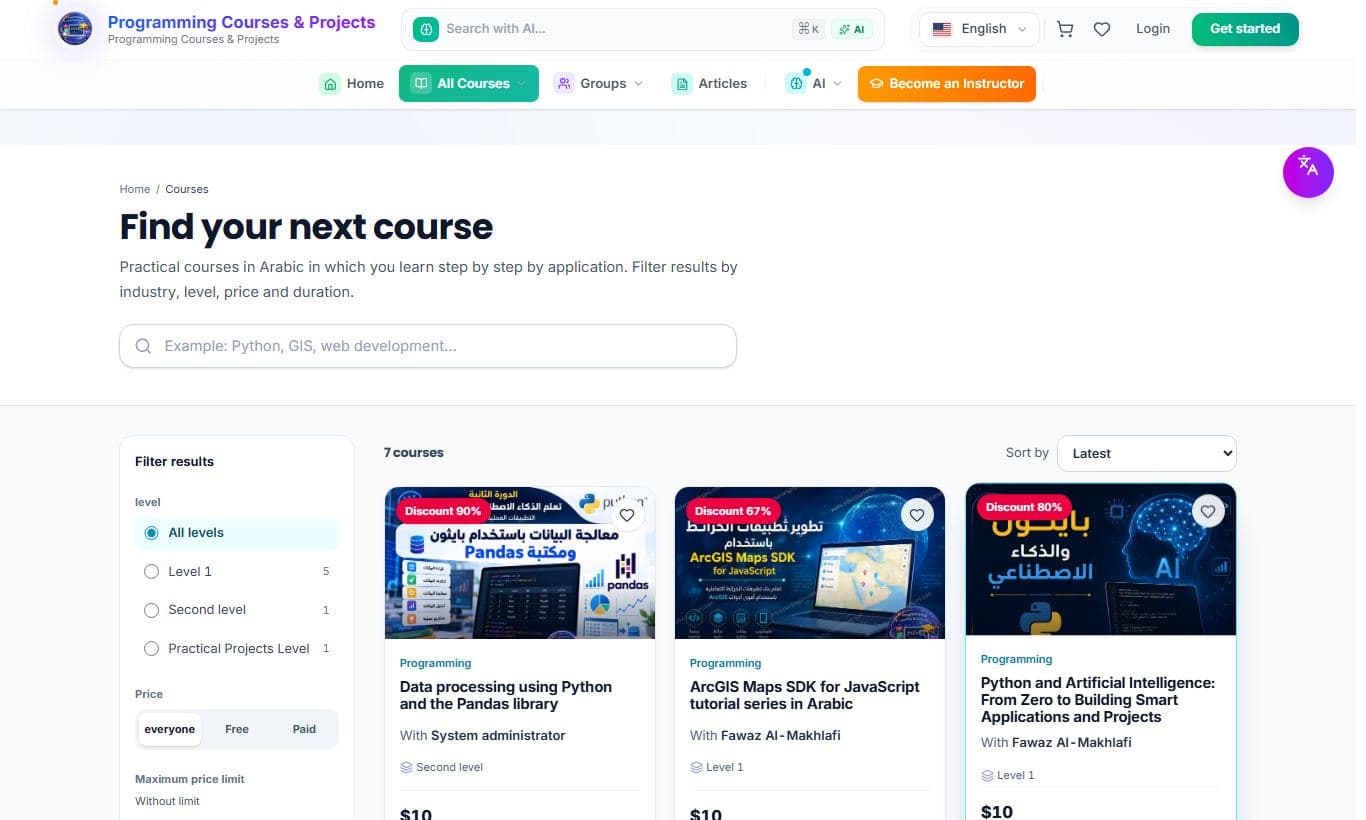
Course catalogue 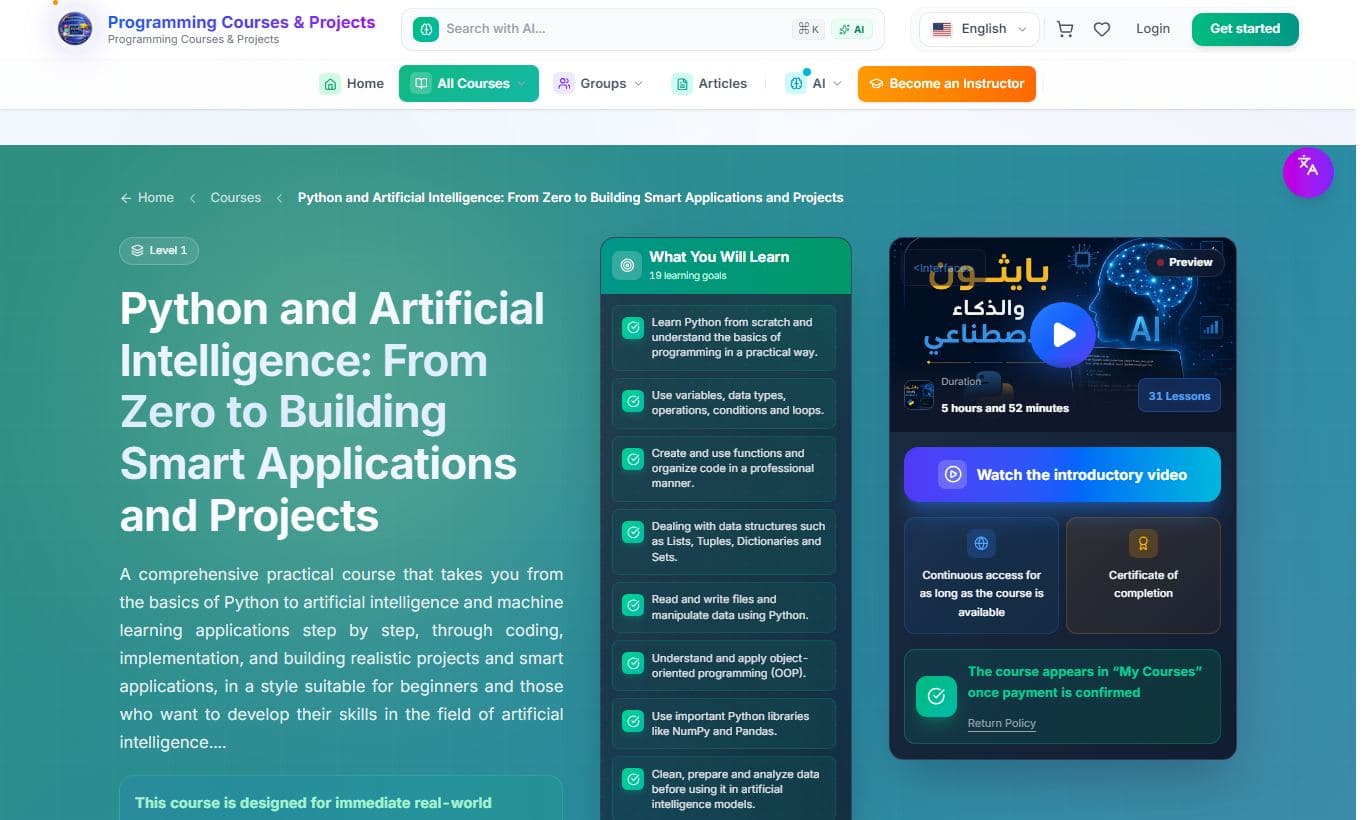
Course page: Python and Artificial Intelligence 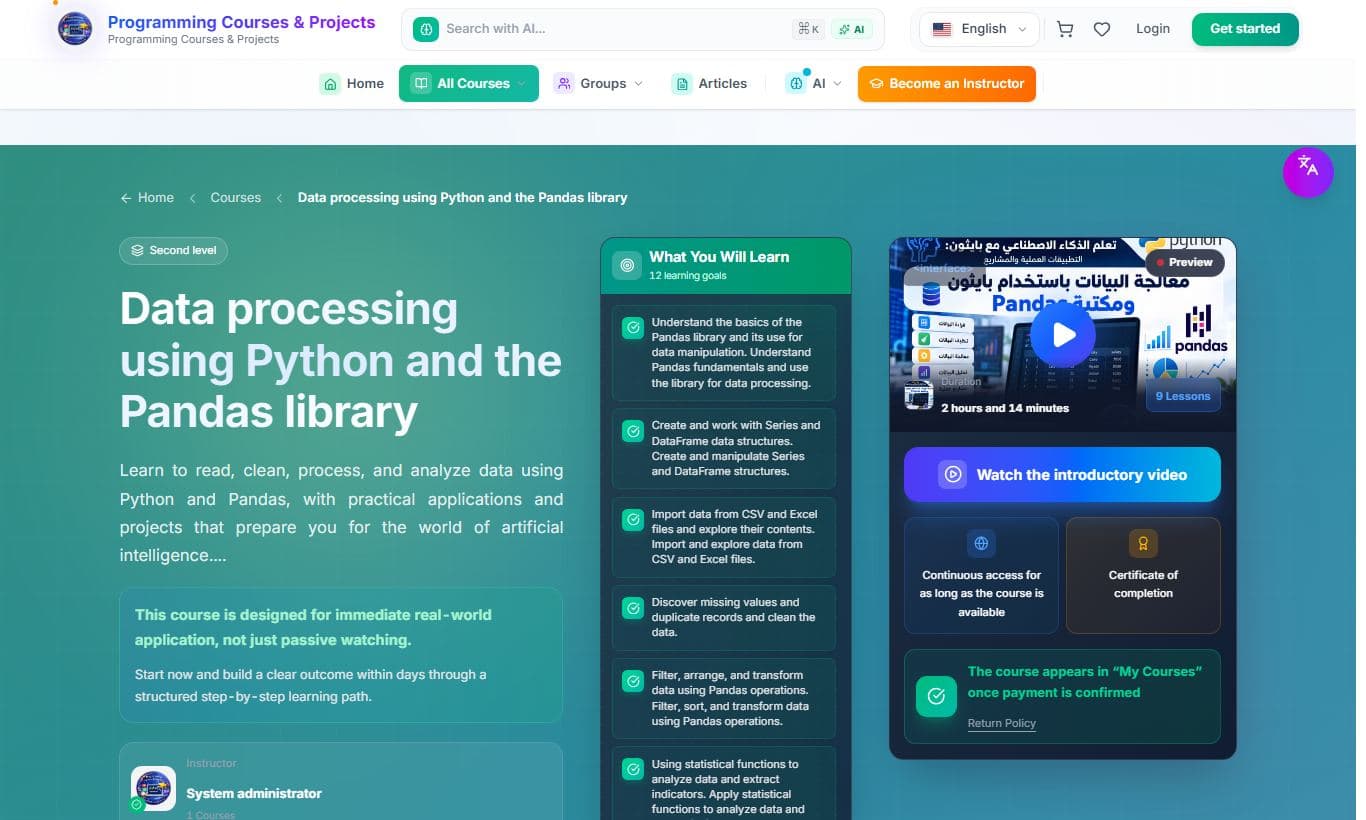
Course page: Data processing with Pandas 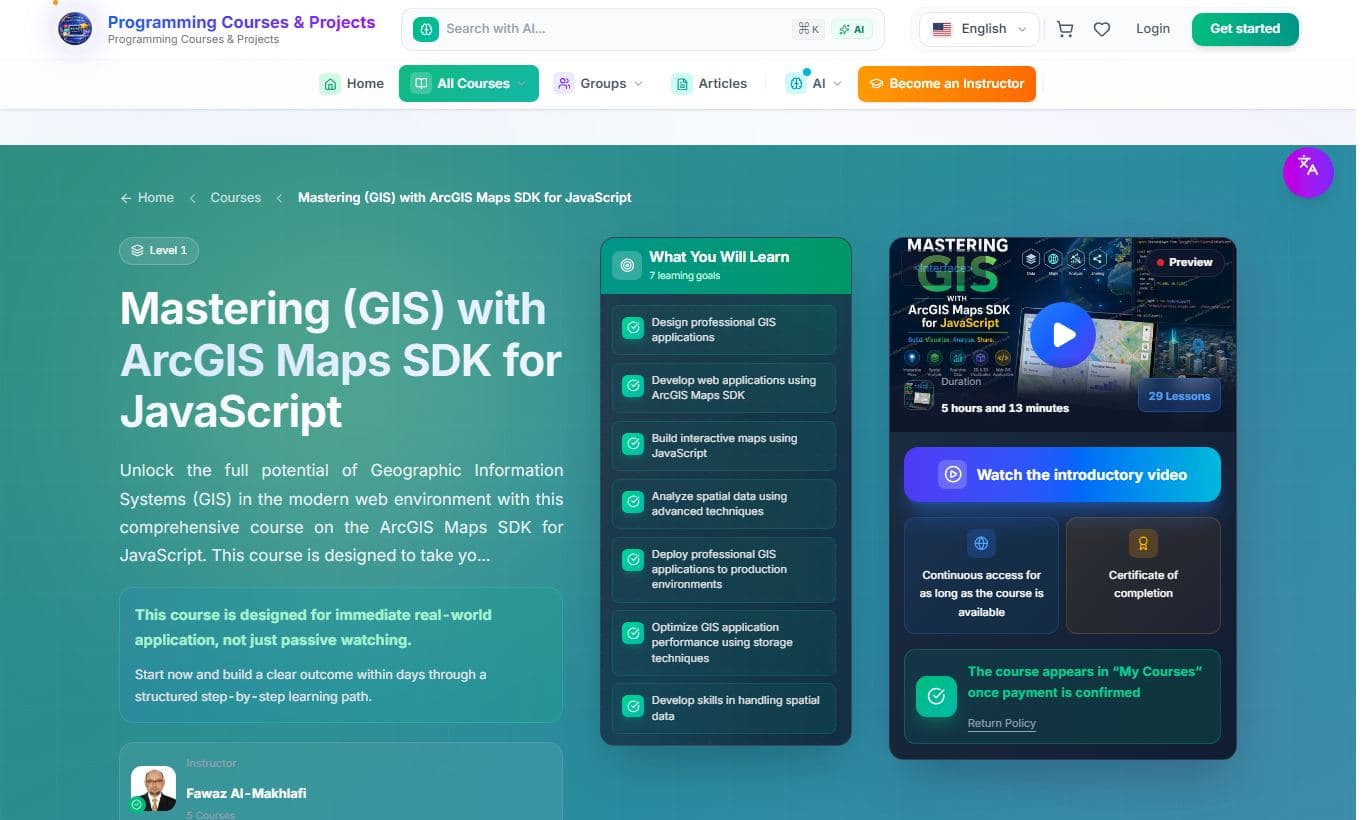
Course page: Web GIS with the ArcGIS Maps SDK
Time-limited promotional banners were hidden. The interface was shown in English; course content is in Arabic.
Sample projects and source code
Each sample runs in the demo centre, so you can read the code and see it work.
Object-oriented Python (lecture 26)
The real lecture code, explained line by line, with an exercise that is checked automatically.
Run it →Python with electronics: Lab Monitor
A program that reads sensor values over a serial link and reports them, with automated tests. Written for the demo and tested against a simulated board.
Run the tests →Data processing with Pandas
Load a table of results, clean it and summarise it by course.
Run it →Web GIS with JavaScript
A web map that loads a public feature layer, with the code explained.
Read the code →
The learner journey
From choosing a course to the certificate: the demo centre walks through the student, instructor and supervisor journeys and marks each step as available today or planned.
See the journeys →Working with institutions
We start from your learners and outcomes, propose a pilot or a curriculum mapping, and confirm everything in writing. Prices are given only in a formal quotation approved by the company.